Why Toilets Are So Difficult with Arthritic Knees
If you’ve got arthritic knees, you’ve probably noticed this:
- Sitting down isn’t too bad
- But getting back up? That’s the real struggle
And it’s not just you, there’s a very real reason for it.
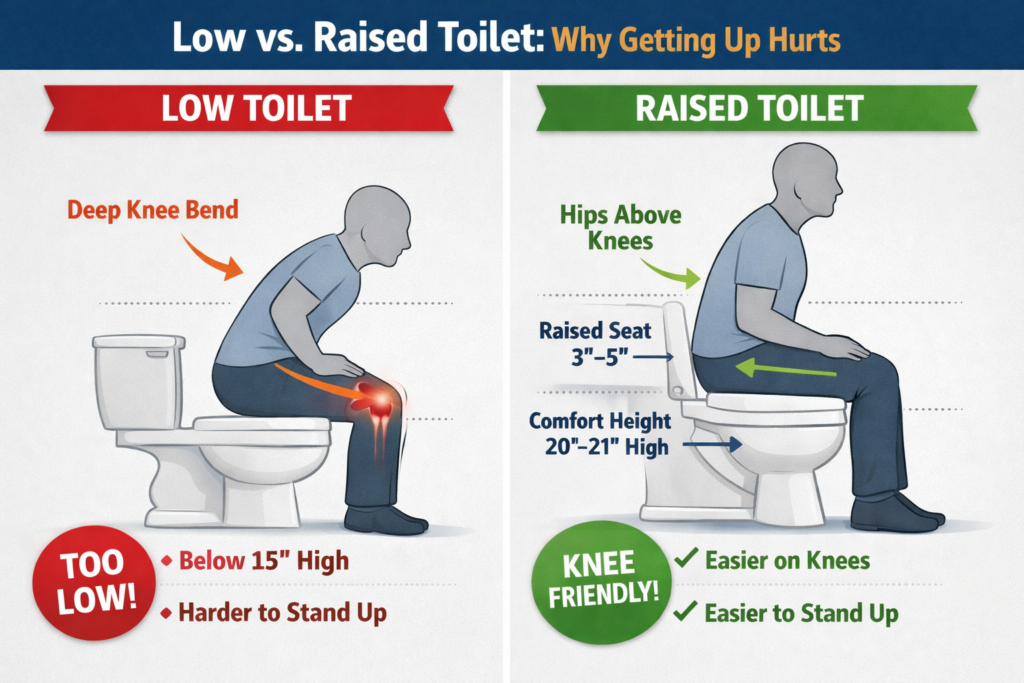
Most standard toilets are quite low, which means:
- Your knees bend deeply
- Your body weight shifts forward
- Your knee joint takes a lot of load
In fact, standing up from a low toilet can put significantly more pressure through your knees than walking.
So every time you use the toilet, you’re essentially doing a mini squat… often with painful joints.
The Real Problem: It’s Not Just Arthritis – It’s the Setup
Here’s the key thing most people miss:
It’s not just your knees
It’s the height and lack of support
A low toilet + no arm support =
- More strain
- More pain
- More hesitation (and even anxiety about using the toilet)
That’s why small changes can make a huge difference very quickly.
What Makes a Toilet Knee-Friendly?
1. Height Is Everything
This is the single most important factor.
Ideally:
- Your hips should be level with or slightly above your knees
- This reduces how far you have to bend
- And makes standing up much easier
Even a few extra inches can feel like a massive relief
2. Arm Support (Often Overlooked!)
One of the biggest struggles is:
“I’ve got nothing to push off.”
Adding arm support allows you to:
- Use your arms (not just your knees)
- Reduce pressure through the joint
- Feel more stable and confident
Options include:
- Fixed grab rails
- Freestanding toilet frames
- Fold-down supports
3. Stability & Confidence
If something feels wobbly or awkward, your body will:
- tense up
- move less efficiently
- and often make pain worse
So whatever you use needs to feel:
✔ solid
✔ secure
✔ easy to use

The Best Toilet Aids for Arthritic Knees
Here are the most helpful options I recommend to patients:
Please note this post contains affiliate links. As an Amazon Associate, I earn from qualifying purchases at no extra cost to you. My intent to help you find the most appropriate products for you.
1. Raised Toilet Seats
- Sit on top of your existing toilet
- Add extra height instantly
- Easy to install
Great for: quick, affordable improvement
Homecraft Raised toilet seat – without lid (This toilet seat I have used with patients for over 25 years) – Click here for link.
Homecraft Raised toilet seat – with lid – Click here for link.
2. Toilet Frames (With Arms)
- Surround the toilet with sturdy handles
- Give you something to push up from
Great for: added confidence + support
Mowbray Lite Adjustable Toilet Seat & Frame is the one I would recommend sturdy but not bulky, top rated and good price. – Click here for link
3. Comfort Height Toilets
- Taller than standard toilets
- Often called “chair-height” toilets
Great for: long-term solution if renovating
Choose a style to suit your taste and bathroom suite.
4. Grab Rails
- Mounted on the wall
- Provide stable hand support
Great for: targeted assistance in small spaces
Permanent fix grab rails – click here for link
Suction/moveable grab rails – click here for link
Simple Technique Changes That Help Immediately
Even without equipment, small tweaks can help:
- Bring your feet slightly back before standing
- Lean forward (“nose over toes”)
- Push through your arms if possible
- Avoid rushing — slower is often easier
These reduce strain and improve control.
A Quick (But Important) Note on Strength
A better setup helps immediately and that’s important.
But longer-term, what really makes the biggest difference is:
improving your strength and control
Because ultimately, your knees need to:
- handle load
- support movement
- and feel reliable again
The ideal approach is both:
✔ make daily life easier
✔ gradually build your strength
Final Thoughts
If you’re struggling with the toilet, it can feel frustrating… and honestly, a bit disheartening.
But this is one of those areas where:
small changes can make a huge difference
Raising the height
Adding support
Improving technique and most importantly building strength.
These aren’t big, complicated fixes, but they can take something that feels difficult and make it feel manageable again.
Take care, Helen
Helen Manders BSc (Hons) MCSP HCPC
Chartered Physiotherapist Improving Arthritic Knees Since 2001
If You Want More Help
If knee pain is affecting your daily life, I’ve put together a free masterclass where I walk you through:
- how to settle flare-ups
- what actually helps (and what doesn’t)
- simple ways to start improving your knees